


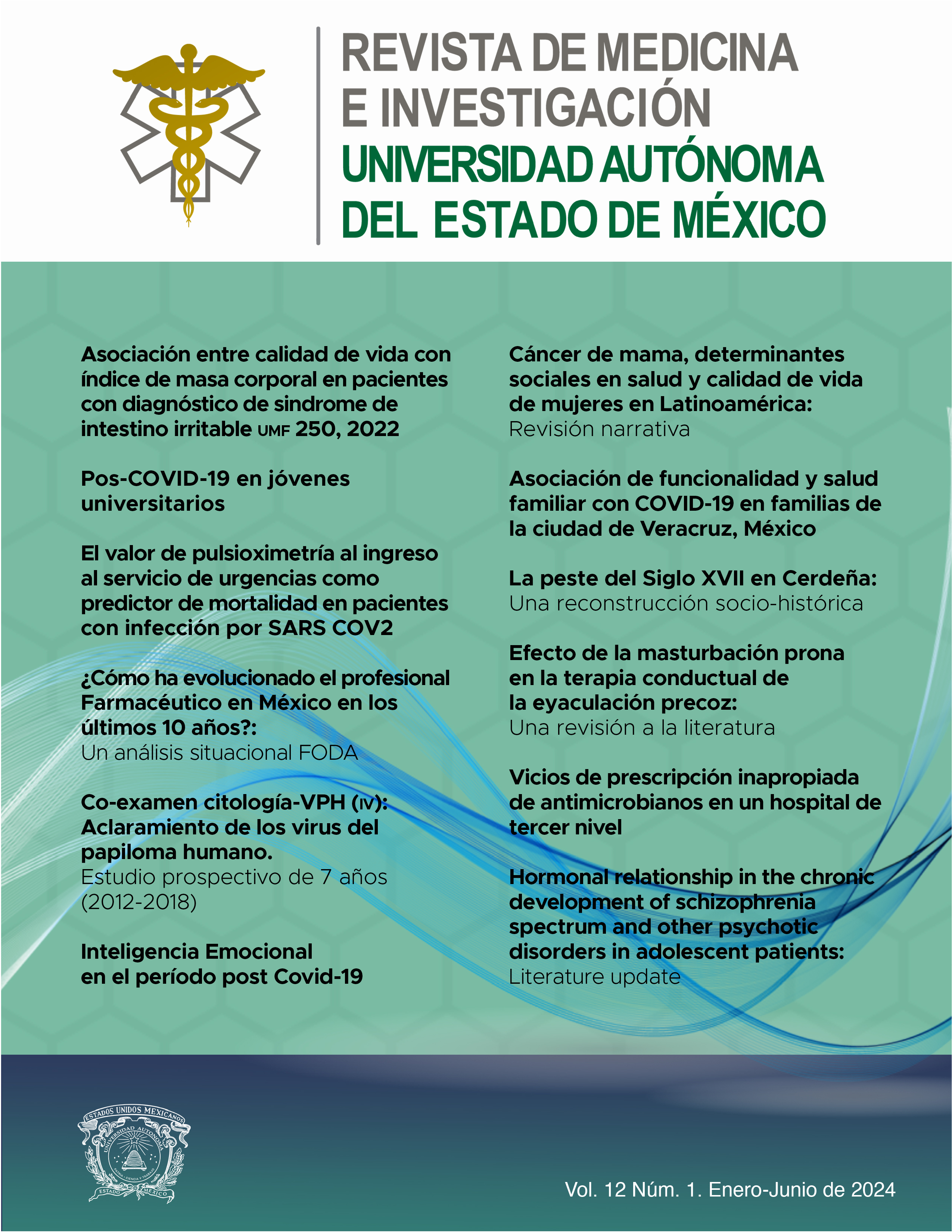
CO-EXAMEN CITOLOGIA-VPH (IV) ACLARAMIENTO DE LOS VIRUS DEL PAPILOMA HUMANO. ESTUDIO PROSPECTIVO DE 7 AÑOS ( 2012-2018).
Article Sidebar
Publicado
feb 2, 2024
##plugins.pubIds.doi.readerDisplayName##
https://doi.org/10.36677/medicinainvestigacion.v12i1.20755
Main Article Content
López Olmos, Jorge
 http://orcid.org/0000-0001-8924-6100
 http://orcid.org/0000-0001-8924-6100
Resumen
Objetivo: Estudio del aclaramiento de los VPH (virus del papiloma humano): 16, 18 y otros de alto riesgo (ar).
Diseño: Con la técnica rcp, reacción en cadena de la polimerasa (pcr, por sus siglas eninglés), a partir de una serie de 160 casos con 3 o más valores, en los años 2012-2018, dentro del co-examen citología. VPH, anual.
Resultados: La edad media fue 37,54 años, la paridad media 0,87. Nuligestas, 42,5%, y menopáusicas 8,12%. No utilizaban contracepción en 51,87%. Antecedente de conización en 20%. Citología inicial
negativa en 51,25%. ASCUS (atipias de significado incierto) en 17,5%. LSIL (lesión escamosa intraepitelial de bajo grado) en 11,25%. VPH inicial positivo en 50%. El tipo más frecuente fue otros de AR en 72,5%.
En el aclaramiento, se negativizaron de 69 casos positivos: 27,53% al primer año, y 2,89% al 4o
año. De 91 casos negativos al primer año, hubo adquisición de novo, se hicieron positivos en 10,98% al primer año y 1,09% al 4o año.
Conclusiones: 1). El punto de inflexión del aclaramiento es, el primer año, siendo 83% para el tipo 16; y 73% para el tipo 18 y 47% para el tipo otros, ambos en el 2o año. 2). El pico de contagio máximo es al 2o año, en 15,46%. 3). LSIL tiene VPH (+) en 90,90% (p< 0,001), versus ASCUS en 45,16%.
Diseño: Con la técnica rcp, reacción en cadena de la polimerasa (pcr, por sus siglas eninglés), a partir de una serie de 160 casos con 3 o más valores, en los años 2012-2018, dentro del co-examen citología. VPH, anual.
Resultados: La edad media fue 37,54 años, la paridad media 0,87. Nuligestas, 42,5%, y menopáusicas 8,12%. No utilizaban contracepción en 51,87%. Antecedente de conización en 20%. Citología inicial
negativa en 51,25%. ASCUS (atipias de significado incierto) en 17,5%. LSIL (lesión escamosa intraepitelial de bajo grado) en 11,25%. VPH inicial positivo en 50%. El tipo más frecuente fue otros de AR en 72,5%.
En el aclaramiento, se negativizaron de 69 casos positivos: 27,53% al primer año, y 2,89% al 4o
año. De 91 casos negativos al primer año, hubo adquisición de novo, se hicieron positivos en 10,98% al primer año y 1,09% al 4o año.
Conclusiones: 1). El punto de inflexión del aclaramiento es, el primer año, siendo 83% para el tipo 16; y 73% para el tipo 18 y 47% para el tipo otros, ambos en el 2o año. 2). El pico de contagio máximo es al 2o año, en 15,46%. 3). LSIL tiene VPH (+) en 90,90% (p< 0,001), versus ASCUS en 45,16%.
##plugins.generic.usageStats.downloads##
##plugins.generic.usageStats.noStats##
Article Details
Como citar
JORGE, López Olmos,.
CO-EXAMEN CITOLOGIA-VPH (IV).
Medicina e Investigación Universidad Autónoma del Estado de México, [S.l.], v. 12, n. 1, p. 8-15, feb. 2024.
ISSN 2594-0600.
Disponible en: <https://medicinainvestigacion.uaemex.mx/article/view/20755>. Fecha de acceso: 03 oct. 2026
doi: https://doi.org/10.36677/medicinainvestigacion.v12i1.20755.
Número
Sección
Artículos

Esta obra está bajo licencia internacional Creative Commons Reconocimiento-NoComercial-SinObrasDerivadas 4.0.
Citas
de SanJose S, Brotons M, Pavon MR. The natural history of human papillomavirus infection. Best Pract Res Clin Obstett Gynecol. 2017; 30: 1-12.
Di Paola M, Sani, C, Clemente AMa, Iossa A, Perissi E et al. Characterization of cervico-vaginal microbiota in women developing persistent high-risk human papillomavirus infection. Scientific Reports. 2017; 7, 10200, doi: 10.1038.
Shannon B, Yi TJ, Perusini S, Gajer P, Ma B, Humphrys MS, Thomas-Pavanel J. et al. Association of HPV infection and clearance with cervicovaginal immunology and the vaginal microbiota. Mucosal Immunol. 2017; 10: 1310-1319.
Richardson H, Abrahamowicz M, Tellier P-P, Kelsall G, Du Bergor R, Ferenczy A, Coutlee F y Franco EL. Modifiable risk factors asocciated with clearance of type-specific cervical human papillomavirus infections in a cohort of university students. Cancer Epidemiol Biomarkers Prev, 2005; 14: 1149-11565.
Hogewoning CJA, Bleeker MCG, Van Der Brule AJC, Voorhost FJ, Snidjers PJF, Berkhof J, Westenend PJ y Meijer CJLM. Condom use promotes regression of cervical intraepithelial neoplasia and clearance of human papillomavirus: a randomized clinical trial. Int J cancer, 2003; 107: 811-816.
Grainge MJ, Seth R, Guo L, Neal KR, Coupland C, Vryenhoef P, Johnson J y Jenkins C. Cervical human papillomavirus screening among older women. Emerg Infect Dis. 2005; 11: 1680-1685.7. Lopez-Olmos J. Infección por virus del papiloma humano (vph): aclaramiento en el tiempo. Estudio prospectivo de 5 años. Toko-Gine Pract. 2016; 75: 21-29.
Goodman MT, Shvetsov YB, Mc Duffie K, Wilkins LR, Zhu X, Thompson PJ, Ning L, Killeen, J, Kamemoto L y Hernandez BY. Prevalence, acquisition, and clearance of cervical human papillomavirus infection among women with normal cytology; Hawaii Human papillomavirus Cohort Study. Cancer Res.
2008; 68: 8813-8824.
Sammarco ML, Del Riccio I, Tamburro M, Grasso, GM y Ripabelli, G. Type-spcific persistence and associated risk factors of human papillomavirus infections in women living in central Italy. Eur J Obstet Gynecol Reprod Biol. 2013; 168: 222-226.
Ingabire C, Lim MK, Won, Y-J y Oh, J-K. Human papillomavirus genotype-specific persistence and potential risk factors among Korean women: results from a 2-year follow-up study. Cancer Res Treat, 2017, doi .org/10.4143.
Travassos AG, Netto E, Xavier-Souza E, Nobrega I, Adami K, Timbo M, Abbehusen K, Fernandes S, Duran C, Haguinara T, Ferreira F, Brites C. Predictors of hpv incidence and clearance in a cohort of Brazilian hiv-infected
women. Plos One. 2017, doi.org/ 10.1371.
Trevissan A, Schlecht NF, Ramanakumar AV, Villa LL, Franco EL. The Ludwig-Mc Gill Study Group. Human papillomavirus type 16 viral load measurement as a predictor of infection clearance. J General Virol. 2013; 94: 1850-1857.
Insinga RP, Perez G, Wheeler CM, Koutsky LA, Garland SM et al. Incident cervical hpv infections in young women: transition probabilities for CIN and infection clearance. Cancer Epidemiol Biomarkers Prev, 2011; 20: 287-296.
Brummer O, Hollwitz B, Böhmer G, Kühnle H, Petay KU. Human papillomavirus-type persistence patterns predict the clinical outcome of cervical intraepithelial neoplasia. Gynecol Oncol. 2006; 102: 517-522.
Siegler E, Goldberg Y, Baruch-Finkel T, Shakep-Mishan P, Segev Y, Machuli L, Siegler Y, Auslender, R y Lavie, O. Positive correlation between clearance of high-risk human papillomavirus and lack of residual disease after loop excisional the transformation zone in early stage cervical cancer. J Low Genit Tract Dis. 2017; 21:294-298.16.
Zhang G, Lang J, Shen K, Zhu L, Xiang Y. High-risk human papillomavirus infection clearance following conization among patients with cervical intraepithelial neoplasia grade 3 aged at least 45 years. Int J Gynecol Obstet,
2017; 136: 47-52.
Thomas R, Steben M, Greenwald Z, Stutz M, Rodier C, De Angelis F, Rampakakis, E. Recurrence of human papillomavirus external genital wart infection among high-risk adults in Montreal, Canada. Sex Transmit Dis. 2017; 0(0): 1-7.
Ermel A, Shew ML, Imburgia TM, Brown M, Qadari B, Tong Y, Brown DR. Redetection of human papillomavirus type 16 infections of the cervix in midadult life.Papillomavirus Research, 2018. 5: 75-79.
Di Paola M, Sani, C, Clemente AMa, Iossa A, Perissi E et al. Characterization of cervico-vaginal microbiota in women developing persistent high-risk human papillomavirus infection. Scientific Reports. 2017; 7, 10200, doi: 10.1038.
Shannon B, Yi TJ, Perusini S, Gajer P, Ma B, Humphrys MS, Thomas-Pavanel J. et al. Association of HPV infection and clearance with cervicovaginal immunology and the vaginal microbiota. Mucosal Immunol. 2017; 10: 1310-1319.
Richardson H, Abrahamowicz M, Tellier P-P, Kelsall G, Du Bergor R, Ferenczy A, Coutlee F y Franco EL. Modifiable risk factors asocciated with clearance of type-specific cervical human papillomavirus infections in a cohort of university students. Cancer Epidemiol Biomarkers Prev, 2005; 14: 1149-11565.
Hogewoning CJA, Bleeker MCG, Van Der Brule AJC, Voorhost FJ, Snidjers PJF, Berkhof J, Westenend PJ y Meijer CJLM. Condom use promotes regression of cervical intraepithelial neoplasia and clearance of human papillomavirus: a randomized clinical trial. Int J cancer, 2003; 107: 811-816.
Grainge MJ, Seth R, Guo L, Neal KR, Coupland C, Vryenhoef P, Johnson J y Jenkins C. Cervical human papillomavirus screening among older women. Emerg Infect Dis. 2005; 11: 1680-1685.7. Lopez-Olmos J. Infección por virus del papiloma humano (vph): aclaramiento en el tiempo. Estudio prospectivo de 5 años. Toko-Gine Pract. 2016; 75: 21-29.
Goodman MT, Shvetsov YB, Mc Duffie K, Wilkins LR, Zhu X, Thompson PJ, Ning L, Killeen, J, Kamemoto L y Hernandez BY. Prevalence, acquisition, and clearance of cervical human papillomavirus infection among women with normal cytology; Hawaii Human papillomavirus Cohort Study. Cancer Res.
2008; 68: 8813-8824.
Sammarco ML, Del Riccio I, Tamburro M, Grasso, GM y Ripabelli, G. Type-spcific persistence and associated risk factors of human papillomavirus infections in women living in central Italy. Eur J Obstet Gynecol Reprod Biol. 2013; 168: 222-226.
Ingabire C, Lim MK, Won, Y-J y Oh, J-K. Human papillomavirus genotype-specific persistence and potential risk factors among Korean women: results from a 2-year follow-up study. Cancer Res Treat, 2017, doi .org/10.4143.
Travassos AG, Netto E, Xavier-Souza E, Nobrega I, Adami K, Timbo M, Abbehusen K, Fernandes S, Duran C, Haguinara T, Ferreira F, Brites C. Predictors of hpv incidence and clearance in a cohort of Brazilian hiv-infected
women. Plos One. 2017, doi.org/ 10.1371.
Trevissan A, Schlecht NF, Ramanakumar AV, Villa LL, Franco EL. The Ludwig-Mc Gill Study Group. Human papillomavirus type 16 viral load measurement as a predictor of infection clearance. J General Virol. 2013; 94: 1850-1857.
Insinga RP, Perez G, Wheeler CM, Koutsky LA, Garland SM et al. Incident cervical hpv infections in young women: transition probabilities for CIN and infection clearance. Cancer Epidemiol Biomarkers Prev, 2011; 20: 287-296.
Brummer O, Hollwitz B, Böhmer G, Kühnle H, Petay KU. Human papillomavirus-type persistence patterns predict the clinical outcome of cervical intraepithelial neoplasia. Gynecol Oncol. 2006; 102: 517-522.
Siegler E, Goldberg Y, Baruch-Finkel T, Shakep-Mishan P, Segev Y, Machuli L, Siegler Y, Auslender, R y Lavie, O. Positive correlation between clearance of high-risk human papillomavirus and lack of residual disease after loop excisional the transformation zone in early stage cervical cancer. J Low Genit Tract Dis. 2017; 21:294-298.16.
Zhang G, Lang J, Shen K, Zhu L, Xiang Y. High-risk human papillomavirus infection clearance following conization among patients with cervical intraepithelial neoplasia grade 3 aged at least 45 years. Int J Gynecol Obstet,
2017; 136: 47-52.
Thomas R, Steben M, Greenwald Z, Stutz M, Rodier C, De Angelis F, Rampakakis, E. Recurrence of human papillomavirus external genital wart infection among high-risk adults in Montreal, Canada. Sex Transmit Dis. 2017; 0(0): 1-7.
Ermel A, Shew ML, Imburgia TM, Brown M, Qadari B, Tong Y, Brown DR. Redetection of human papillomavirus type 16 infections of the cervix in midadult life.Papillomavirus Research, 2018. 5: 75-79.